


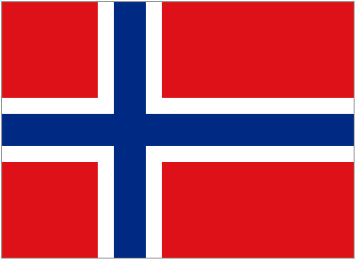

Brazil 1-2 Norway: The Beautiful Game Humbled at the World Cup
SportSignals Match Desk · Football analysis desk ·
There is a particular kind of silence that falls over a stadium when Brazil concede late. Not the silence of shock, exactly, but something more philosophical, as though the crowd is being asked to reconsider everything they thought they understood about the evening. That silence came twice at this World Cup fixture, at the 79th minute and again, with breathtaking audacity, in the 90th, and when it lifted, Norway had done something that felt genuinely improbable before the first whistle: they had beaten Brazil at a World Cup.
A Game of Contradictions
What people do not understand is that possession, on its own, is merely the illusion of control. Norway's 66 per cent of the ball told a story about dominance in one sense, and yet Brazil created five big chances to Norway's three, hit the woodwork, registered 14 shots to Norway's nine, and still lost. This is the beautiful game's most enduring paradox, and it was on full display on this July evening.
Brazil were the team that pressed forward with more urgency when it mattered, more key passes, more crosses, more of the dribbling creativity that defines their football at its finest. They completed ten successful dribbles, nutmegging space open in the Norwegian shape, and yet when the final act was written, it was Norway's name on the scoresheet twice in the last eleven minutes. Football does not always reward the beautiful team. Not tonight.
The Norwegian Method
I have seen this Norway approach from close quarters in my time, and there is a craft to it that deserves genuine respect rather than dismissal. They moved the ball with intelligence, 681 passes completed at an extraordinary 91 per cent accuracy, building patient structures and then transitioning with pace and purpose when the moment arrived. Their 54 long passes were not aimless, they were directional, designed to bypass Brazil's defensive shape and find runners in space.
Eleven successful headers to Brazil's four tells you everything about how Norway approached the aerial contest. They were organised, physical, and disciplined, committing only six fouls across the entire match. In my time playing across four different footballing cultures, I learned that the teams who rarely foul are rarely panicking. Norway were never panicking.
The goal that broke the deadlock, a header in the 79th minute, was the culmination of everything their approach had been building toward. A cross from the left, a well-timed run, and a finish that was clinical precisely because the movement that preceded it had been so patient. You cannot coach that kind of timing. The second goal, a left-foot finish in the 90th minute, both goals credited to the same player with the same assist partner, spoke of a double act that had been rehearsed, that knew each other's movements by instinct.
Brazil's Frustrations and That Penalty Statistic
Brazil had two penalties in this match, which is a remarkable number, and yet they scored only once. The VAR intervention at the 12th minute suggested the match was already operating under a kind of nervous tension from early on. By the time Brazil's substitute received a yellow card and conceded yet another penalty in the 90th minute, the chaos of the final moments had become almost operatic in its cruelty.
What disappointed me most watching Brazil was not their ambition, they created enough chances to win the game comfortably on another evening, but their inability to convert that quality into composure in front of goal. Four big chances missed is a number that haunts you. Brazil hit the woodwork. They registered four shots on target to Norway's five, and ultimately their goalkeeper was beaten twice while making three saves to Norway's four. The margins were fine. The outcome was not.
The substitutions at half-time from Norway's bench, two changes simultaneously, suggested their coach had spotted something in Brazil's shape that he believed could be exploited. The substitution of the player who would go on to assist both goals, introduced precisely at the interval, changed the texture of the second half in ways that only became fully visible when the scoreboard told its story in the final quarter.
What This Means for Brazil
Brazil's form coming into this match had shown a slight downward slope, a loss followed by wins followed by a draw, and a home record that was far less serene than their reputation demands. Conceding four goals at home in their last four home matches before this tournament suggested a vulnerability behind that attacking verve. Norway, who had won all three of their away fixtures in this World Cup campaign without conceding more than one goal per game in those contexts, arrived with precisely the road confidence to exploit it.
What people do not understand is that Brazil's identity is not a weakness, it is simply a vulnerability when met with opponents who have the intelligence and the organisation to absorb beauty and then punish it at the margins. Norway were not lucky. They were prepared, and then they were brilliant in the moments that mattered most.