


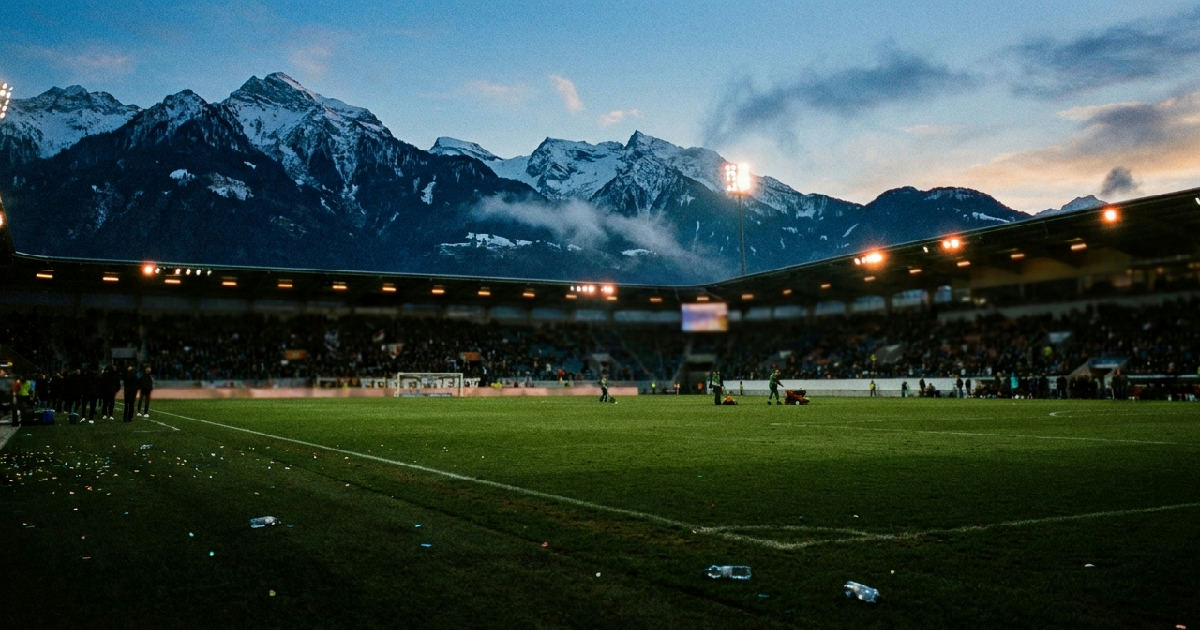
There are matches that matter for the table, and there are matches that matter for something else entirely. Grasshopper against Winterthur on a Tuesday evening in May belonged to the second category. The title race was settled elsewhere, survival battles were already decided or beyond rescue, and so what remained was simply football, played with the freedom that only comes when the weight of consequence has been lifted. The scoreline, 3-2 to the home side, tells you everything and nothing at once.
A Match That Reflected Two Seasons in Miniature
What people do not understand is that the final weeks of a league season, when so much has already been determined, can produce some of the most honest football you will see all year. Players are no longer playing for systems or instructions or the anxiety of a manager watching from the touchline with a clutched notebook. They play for themselves, for their teammates, for the simple pleasure of the thing. That is what this felt like.
Grasshopper, whose season numbers tell a story of genuine quality at the top end of the Swiss Super League, produced the kind of performance that reflects why they have finished this campaign among the strongest sides in the country. Seventy-six goals scored across thirty-six matches is not an accident. It is an expression of how a team thinks about the game, of a collective willingness to commit bodies forward and to trust that the ball, when given room to move, will find a way.
Winterthur, for their part, brought something of their own character to the evening. A team that has scored seventy-two goals this season while conceding sixty-six understands implicitly that caution is not their calling. They come to play. They came here to play. And for long stretches of this match, they made Grasshopper genuinely uncomfortable.
The Architecture of the Goals
Five goals in a match of this nature are not a surprise. They are almost inevitable. When two sides carry this kind of attacking intent into a fixture where the pressure gauge reads zero, you get space, you get chances, and you get goals. What interested me was not the quantity but the quality of the moments that produced them.
Grasshopper's three goals felt like the work of a team that has learned, over the course of a long season, how to read the rhythm of a game and strike at precisely the right tempo. There is a craft to scoring three goals in a match that does not always get the recognition it deserves. Goals do not fall like rain. They are built, sometimes patiently, sometimes in a single burst of brilliance, but always through decisions that are either right or wrong in a fraction of a second. You cannot coach that recognition. You can create the conditions for it, but the moment itself belongs to the player.
Winterthur's two goals were a reminder that their season has not been without its own moments of quality. Sixty-seven goals scored, nearly two per game across the campaign, speaks to an attacking philosophy that is genuine rather than cosmetic. They believe in going forward. Even here, chasing a game on a May evening with nothing material at stake, they believed in it.
What the Season Tells Us About These Two Clubs
When you look at Grasshopper's record across thirty-six games, twenty-four wins and seventy-six goals scored, what you see is a team that has found something approaching consistency in the way they want to play. Thirty-three goals better off than they have conceded. That is not fortune. That is identity, expressed over months rather than moments.
Winterthur's campaign tells a different and perhaps more interesting story. Twelve wins, eleven draws, thirteen defeats, and yet seventy-two goals. There is a generosity of spirit in those numbers, a team that would rather play than protect. In my time as a player, I encountered sides like this in every league I played in. They were never the champions. They were often the most enjoyable opponents. You knew that if you were sharp, you would score. You also knew that if you lost your concentration, so would they.
The gap between their forty-seven points and Grasshopper's seventy-four is significant, but it should not obscure the fact that Winterthur have contributed meaningfully to what has been, by the goal numbers at least, an open and expressive Swiss Super League season.
The Broader Picture of a League That Invites Goals
One of the more striking things about this season's Swiss Super League standings, when you survey them as a whole, is the sheer volume of goals across the division. The top teams have scored heavily, but so have sides in the middle and lower reaches of the table. There is something about the culture of Swiss domestic football, a willingness to press forward rather than sit deep, that produces this kind of arithmetic. It does not always produce beautiful football, but it produces alive football, and there is a value in that which should not be underestimated.
This Grasshopper and Winterthur match was, in that sense, a fitting conclusion to a season that has been defined by goals. Three-two is a scoreline that requires both teams to have expressed something, to have committed, to have taken risks. Neither side played it safe. Neither side chose the quiet option. The beautiful game does not always reward the beautiful team, but on this occasion, the team with the greater quality over the course of the season held on, and that felt right.
A Final Thought
Grasshopper win 3-2. Winterthur lose, but with two goals to their name and with their attacking principles intact. The season ends as it was always going to end, with the better-resourced, more consistent side taking three points. But the manner of the afternoon, open, generous, full of intent from both sides, reminded me of why I have always believed that football at its most interesting is not about who wins. It is about how the game is played, and today, for eighty or ninety minutes in Switzerland, it was played with something approaching joy.


