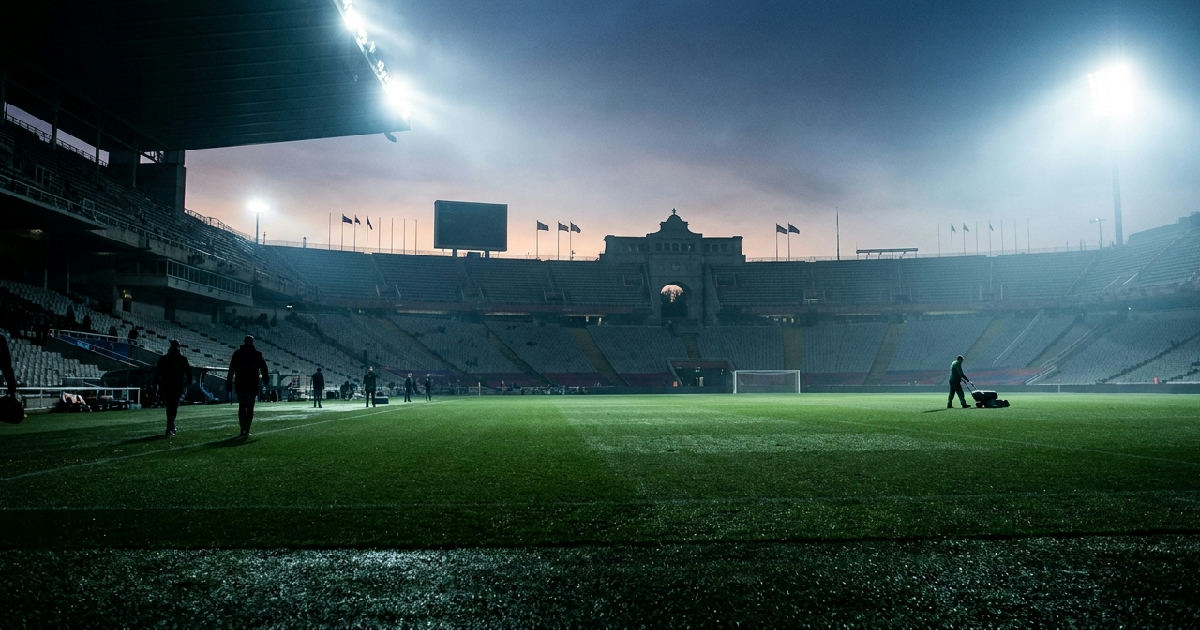
There are goalless draws that leave you with a sense of something witnessed, a contest of wills, a tactical chess match played out with intelligence and discipline across ninety minutes. And then there are goalless draws that simply pass you by, leaving nothing behind except the final whistle and the quiet, slightly melancholy walk back to wherever you came from. Estrela Amadora against Famalicão, on a Monday evening in the Liga Portugal, felt very much like the latter.
The result was a 0-0 draw. Both teams remain where they have spent most of this season, in the lower reaches of a league table that has offered them very little comfort.
Where These Two Sides Stand
What people do not understand is that late-season matches between two teams separated by nothing more than positional pride can carry a particular kind of tension. The stakes are not immediately obvious, but they are there. Both Estrela Amadora and Famalicão have spent this campaign navigating the uncomfortable territory of the lower half of the Liga Portugal standings, and a point earned here, however uninspiring its origins, is still a point placed carefully in the column.
After thirty-three matches played, the league table tells a story of a season that has tested both clubs considerably. The upper reaches of the division have been dominated by sides playing football of a different order entirely, and the gap between the summit and these two clubs represents more than mere points. It represents a difference in quality, in resources, and in the kind of collective belief that separates teams who compete for titles from those who compete, week after week, simply to remain.
A Match Without a Defining Moment
The data available to us is sparse, and in some ways that sparseness is itself instructive. When a match produces no goals and leaves behind no clear moments of individual brilliance or tactical revelation worth recording in detail, it tells you something about the nature of the occasion. Neither goalkeeper was truly tested in a manner that demanded they produce something extraordinary. Neither side found a player willing or able to impose himself on proceedings in a way that broke the equilibrium.
In my time as a player, I experienced matches like this one. You go through the motions, you fulfil your professional obligation, and somewhere in the middle of the second half you become aware that nothing is going to happen unless someone decides to make it happen. On this particular evening in Amadora, nobody decided.
What disappoints me about performances like this is not the absence of a winning goal. Football does not owe anyone a winning goal. What disappoints is the absence of craft, of the kind of individual intelligence that can unlock a match when collective patterns have failed to do so. A single moment of quality, a clever movement in behind, a touch that shifts the angle of a cross, a forward who holds the ball long enough to create something from nothing. These are the things that separate a 0-0 draw from a 0-0 draw. One can be barren and the other can still carry beauty in its construction, even without a conclusion.
The Signals and What They Told Us
Before this match, the signals generated for this fixture pointed toward a game that was essentially uncertain across every market. Both teams to score was rated at 53 per cent probability, barely above the midpoint of confidence. Over 2.5 goals was assessed at 51 per cent. Famalicão to win was placed at 48.5 per cent. These are not numbers that inspire conviction in any direction, and the match itself vindicated that uncertainty entirely, arriving at an outcome, a 0-0 draw, that sat outside all three signals but was never exactly a surprise given how closely the assessments were clustered around coin-flip territory.
The Famalicão result signal was the one with any meaningful edge attached to it, however modest, and that signal lost. The beautiful game does not always reward the beautiful team, and it rarely rewards the most probable outcome simply because probability was calculated carefully beforehand.
The Broader Picture for Both Clubs
Looking at the full table after thirty-three rounds of football, the picture for both sides requires some honest reflection. The top of this league has been extraordinary this season. The leading team carries eighty-five points from thirty-three games, with twenty-seven victories and only two defeats. That is a standard of consistency that belongs to a different conversation entirely from the one happening at the bottom half of the table.
For clubs like Estrela Amadora and Famalicão, the final rounds of the season carry the quiet weight of consolidation. A point here keeps a position intact, keeps a gap manageable, keeps next season's planning on stable ground. There is dignity in that, even when it produces nothing that a neutral observer would choose to remember.
What I would say to anyone watching these clubs from the outside is this: the footballers on the pitch on a Monday evening in late May, playing a goalless draw in front of modest crowds, are still professional footballers. They still care. The craft may not have been on display, the intelligence of movement may not have illuminated the occasion, but the desire to compete, to not lose, to hold firm when nothing is flowing, that is also football. Sometimes the most honest thing a match can do is reveal its own limitations without pretending otherwise.
Final Thought
A 0-0 draw between two teams in the lower half of the Liga Portugal is not the kind of result that demands deep mourning or extensive celebration. It is what it is, a shared point, an empty scoreline, a late-season evening that passed without incident. I find myself neither disappointed by the absence of goals nor particularly moved by what replaced them. The occasion simply was. Both sides will prepare for their final fixture of the campaign and consider what this season has taught them, which, if nothing else, is perhaps the most valuable exercise of all.