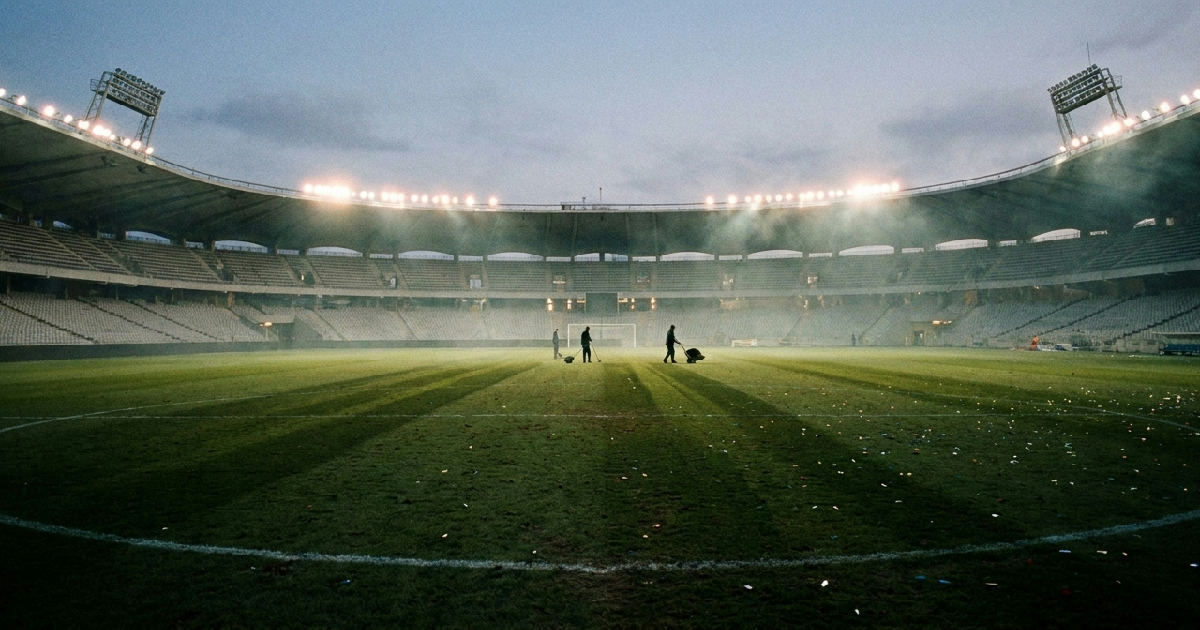
There is a particular kind of match in late-season football that tells you everything about where two clubs are. Not in a dramatic way, not through a collapse or a comeback, but simply through the texture of a 1-1 draw that both sides will accept and move on from. Angers versus Strasbourg on a Sunday evening in May was precisely that kind of match.
The Context: What Was Actually at Stake
Rewind to where both clubs sit in the Ligue 1 table and you understand the frame around this game. The standings data available tells us this league has a dominant force at the top, with the leaders carrying 73 points from 32 games and a goal difference of plus 44. Angers and Strasbourg occupy a very different part of the table. This was not a match shaped by title ambition or European qualification. It was a match shaped by the absence of real consequence, and that absence has a way of showing up in the structure of a game.
The thing nobody is talking about is how much the context of a match dictates the game plan. When preparation in the week before a fixture is not driven by urgency, the patterns you see on the pitch reflect that. Both teams came into this game with something to play for in terms of professional pride and final-day positioning, but neither was under the kind of pressure that produces a compelling tactical contest. That matters when you are trying to understand why a match ends 1-1 rather than producing something more decisive.
What the Model Saw Before Kick-Off
The pre-match signals heading into this fixture pointed toward goals. The model gave Both Teams to Score a 55.8% probability, and Over 2.5 goals a 55.9% chance. Those figures reflect a reasonable expectation of an open game between two sides who are not set up primarily to keep the door shut. The BTTS market was priced at 57% implied probability, which meant the model found almost no edge there. The over 2.5 market, by contrast, sat at a 51.3% implied probability against the model's 55.9%, giving a four-and-a-half point edge that was worth noting.
The Strasbourg win was the headline signal, priced at 2.5 with a model probability of 49.6% against an implied probability of 40%. That is a genuine edge of 9.6%, and at that odds level with that kind of gap it represents the sort of number you pay attention to. In the end, Strasbourg did not win. They drew. The edge was real in the sense that the market was undervaluing Strasbourg's chances, but the result did not follow.
Reading the 1-1
A 1-1 on this kind of occasion is rarely accidental. Watch this: both sides score, neither side dominates, and the final scoreline reflects a match that found a natural equilibrium. That equilibrium is itself a tactical statement. When two teams at similar levels of the table meet with limited external pressure, the pattern that tends to emerge is a loosely structured game where individual moments decide the score rather than any sustained structural advantage.
That is not a criticism of either coaching staff. It is a structural reality of late-season football. The detail that interests me is not how the goals came, because without granular event data I cannot walk you through those moments precisely. What interests me is the broader pattern. A 1-1 between teams in the lower half of Ligue 1 in May confirms a season-long truth about both clubs. Neither has found the consistency to climb the table, and neither has deteriorated enough to be drawn into a relegation battle.
Where Angers Sit and What It Means
The Ligue 1 table at this point in the season shows a significant gap between the top seven and the teams clustered in the middle and lower sections. Angers, as the home side here, were operating in a range of the table where results have consequences only in the most marginal sense. A draw at home to a direct rival in that bracket is the kind of result that neither strengthens nor damages a manager's position.
That said, being at home and not winning is a pattern worth monitoring. Home advantage in football is partly psychological and partly structural, rooted in the comfort of familiar surroundings, a supportive crowd, and the ability to impose your preferred reference points on the game. If Angers are drawing at home to sides at their level, the question for the coaching staff this summer is whether their home structure is sharp enough to create genuine dominance against comparable opposition. That is a coaching issue, and it will need addressing in pre-season preparation.
Strasbourg's Perspective: Credit for the Point
From Strasbourg's side, coming away from an away fixture with a point when the model gave them a near 50% chance of winning is a reasonable outcome. They showed enough to be competitive and enough to keep the game level. Whether that reflects good organisation, a strong individual performance, or simply an open game that ran both ways is something the match footage would reveal.
What the model suggested before kick-off was that Strasbourg were being underestimated by the market. The implied probability of 40% for an away win significantly undersold their chances according to the model's assessment. They did not win, but they did not lose either. In the context of a 9.6% edge and a 2.5 odds price, the signal had logic. The result was not the signal's fault. That distinction matters when you are evaluating the quality of a betting approach over a long run of results.
The Broader Picture
Step back and look at the full Ligue 1 table and the story of this season becomes clear. The top two have pulled significantly clear, with 73 and 67 points respectively from 32 games. The third and fourth placed clubs are on 61 and 60 points, forming a second tier fighting for European places. Then there is a mid-table cluster, and below that a set of clubs managing a season without ambition in either direction.
Angers and Strasbourg both fall within that mid-to-lower range. The 1-1 result is consistent with where they are. It is a result that neither surprises nor concerns. The preparation for next season, the structures they build in the summer, the movement they create through recruitment, those are the details that will determine whether either side spends 2026-27 playing football with genuine purpose.
For now, a draw. Honest, measured, and entirely in keeping with the moment.